
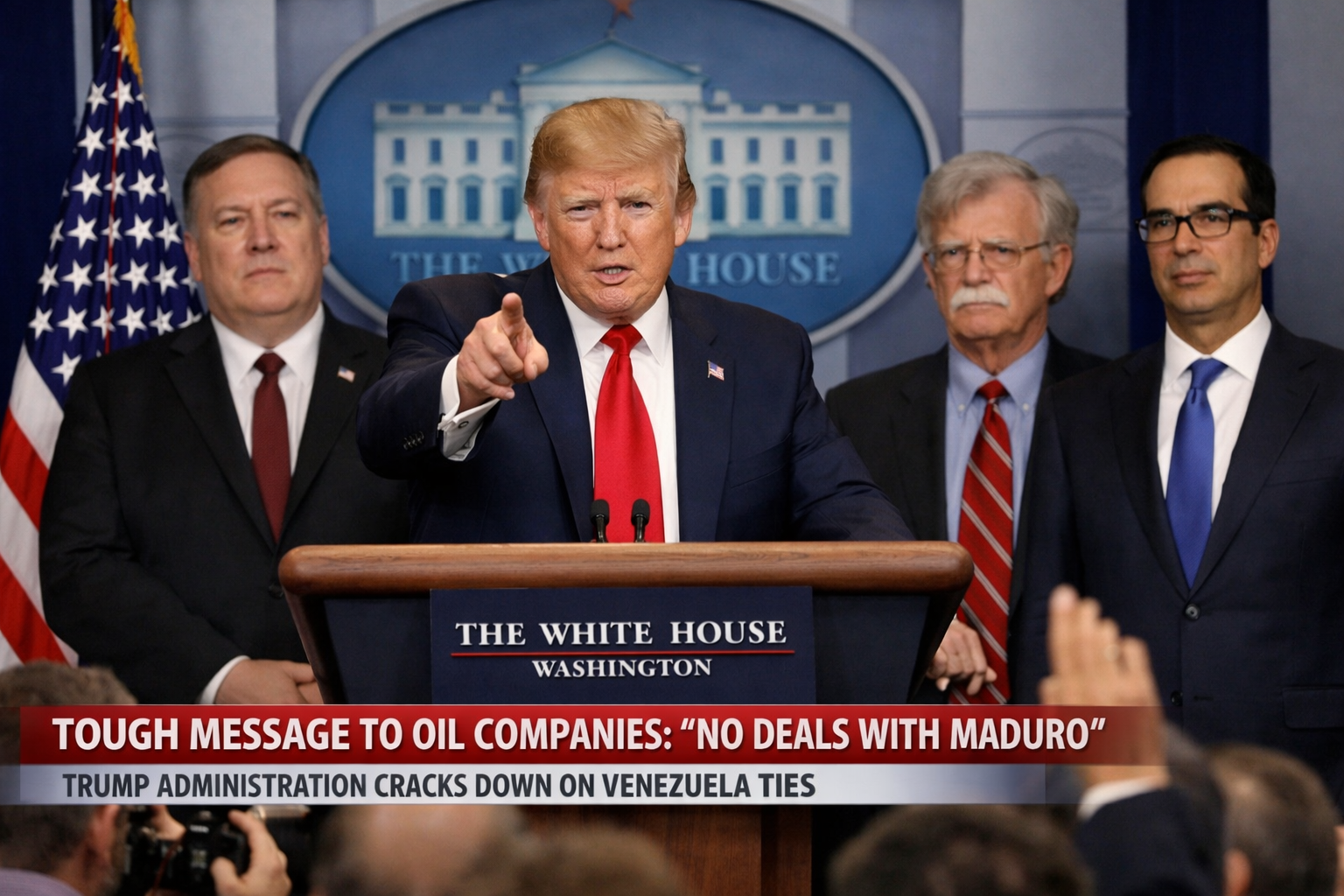
The Trump administration has basically told American oil companies that want to get Venezuela to pay back money owed to them because Venezuela seized their assets that Venezuela will only pay back money to companies Venezuela wants to build up Venezuela’s oil industry again.
White House officials have told energy executives that the Venezuela will only pay back money to American oil companies that are willing to spend money to build up Venezuela’s oil industry. This debut claims her pay back money to them for seized oil crud production materials that Venezuela has: oil wells, pipelines, and oil industry equipment. This statement follows the hostage US Military operations that Venezuelan President Nicholas Maduro performed.
For years America oil companies have wanted Venezuela to pay back money owed because the government took their oil production assets. Now, Venezuela has stated their only option to reimburse America oil companies is to build their oil production facilities.
An oil company executive speaking to others stated the administration’s statement is quite clear: if companies want to be back in the county then they need to be willing to take on the risk.
The executive stated that the proposal has been almost 10 days in the circulation. He explained that Venezuela’s oil facilities are so degraded that firms are not able to estimate the costs or time to restart the oil production. To make matters worse, the oil production facilities in Venezuela are to be restored, but the governing power in Venezuela is not assured and is still to be determined.
During a televised appearance on Saturday, President Trump reinforced the administration’s expectations, and he stated that he is anticipating the spending of US oil companies to boost Venezuela’s oil producing capacity.
Apparently, Trump predicts US firms to spend billions of dollars on the Venezuela oil sector, and he reinforced that the companies will get their money back once the production and the export of oil are to be resumed.
Venezuela has the largest oil reserves in the world. However, due to decades of corruption, underinvestment, and mismanagement, the oil production has been severely weakened. Venezuela is the only country to have undertaken full nationalization of the oil industry in the 1970s, and large scale asset seizures were performed under the Chavez administration, which was almost 2 decades ago.
Although the Venezuela oil reserve is a valuable asset, it is also a large liability. Analysts say there is still a highly unclear landscape amidst the valuable reserve; there is still no clear, comprehensive document outlining the expectations of the US from Venezuela.
Bob McNally, former energy adviser for President George W. Bush and current head of Rapidan Energy Group, said evidence on meticulous plans is scant, apart from the fact that U.S. companies seem to be positioned first in line under any post- Maduro regime.
Oil executives remain troubled by unanswered key questions. These include whether Washington can ensure the safety of the workers, how and in what forms the companies would get compensations, and if the current prices of oil are worth the investments. U.S. crude prices closed Friday at about $57 a barrel, which is close to the post-pandemic margins.
Oil executives are especially interested in how Venezuela’s membership in OPEC can be and how the Venezuelan crude oil can be profitably and competitively exported in the current global economy.
Speaking from his Mar-a-Lago estate, trump said that the oil companies will incur the initial costs, and then, when the oil production is increasing, they will be paid back from the oil revenues.
While the industry continues to communicate with the government, the level of this communication is low. One executive said the discussions are still primitive and poorly organized. In his view, the discussions have been very brief and there have been a lot of gaps.
Today’s Venezuela produces one-third as much oil as they did in the 1970’s despite the country sitting on 300 billion oil reserves. To unlock the reserves, Venezuela would need to invest heavily in drilling equipment, pipelines, ports, and refineries.
Since last year, attendees to the Venezuela Business & Investment Forum have discussed the Venezuela state-owned oil company, PdVSA. One executive stated there are no plans to privatize or dismantle the company, however, a dramatic change in the company’s leadership structure is expected.
Chevron has focused on employee safety and regulatory compliance.
Energy consultant Evanan Romero believes the latest changes could spur American oil producers to return. Romero is on the advisory board for a consultant firm made up of many former PdVSA employees that is focused on rebuilding the oil sector for a post-Maduro Venezuela.
Opinion among the advisors is mixed. Some hold to the belief that the oil sector will continue to operate under government control, while others hold the belief that there will be no return to a foreign investment model without clear market liberalization.
Former State Department official Carrie Filipetti stated that the success of any transition will depend on stability and legitimacy. A chaotic transfer of power, she said, would dissuade U.S. firms from reentering Venezuela.
Others contend that Washington could combine financial instruments, such as government-backed loan guarantees and loans, to mitigate and allocate risk so that early investment will be made. They also state that it would diminish the influence of China, which, through shadow tanker networks that circumvent U.S. sanctions, buys discounted Venezuelan oil.
Energy analysts warn that Venezuela will forever remain a distant opportunity. Sure, heavy Venezuelan crude is perfect for the U.S. Gulf Coast refineries, but inadequate oil prices and the great amount of investment needed make quick returns impossible.
As one analyst said, Venezuela would be a wonderful asset once the political and security issues surrounding it disappear, but as of now, most companies are in a wait and see mode on how it develops.