
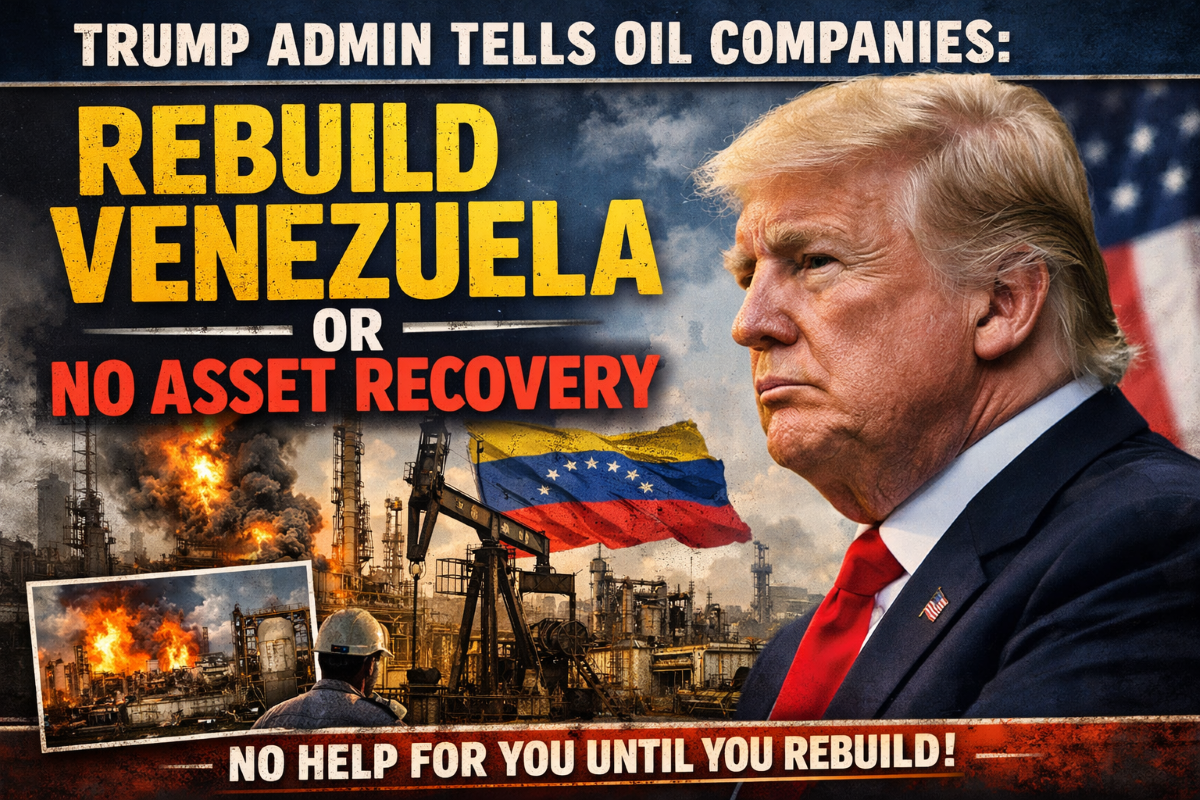
The Trump White House has been sending messages to America’s big oil firms that they need to take steps to rebuild Venezuela’s oil industry if they expect to get the billions worth of assets that the country has taken from them.
American oil companies have been trying to get money from Venezuela’s government for the oil fields, pipelines, and equipment that they have lost for decades. There do seem to be new White House instructions on these payments.
America’s oil companies have been told that the financial recovery of assets will depend on how quickly Venezuela’s oil industry is restored and how much the oil companies are willing to invest.
Rebuild Venezuela’s oil industry and then you will get paid.
These statements have been made after US troops captured the Venezuelan President Nicolás Maduro. He will be the center of attention until someone else is named the leader of that country and it will be a long wait until the country is stabilized.
Leaders in the oil industry continue to display worry.
One industry participant stated that, “The oil infrastructure condition is worse than anybody can measure.” and continued to explain the conditions. “You are being asked to commit billions and with no clarity on leadership, security, or timelines.”
Industry professionals claim the proposition has been within industry contacts for about ten days.
Trump Pledges To Invest Heavily In U.S. Oil
During a televised press conference, Donald Trump pledged that the U.S. would rely on its oil companies to unite Venezuela’s oil industry. Prior to this press conference, Trump made the same comments about oil companies investing to Venezuela.
Venezuela possesses one of the largest reserves of oil in the world, but because of plumbing management, and political issues, their ability to produce has been drastically reduced.
Needs Billions To Turn It Around
Venezuela’s oil industry was nationalized in the 1970’s, and under the leadership of Hugo Chávez, Venezuela obtained even further oil industry assets. Output has diminished further since that time.
While the United States has imposed sanction restrictions against the Maduro regime, oil has been trading at an average of $57 a barrel. With prices this low, the United States will not be getting involved in oil trading. U.S. oil production is estimated at a low one-third, and reserves on the Venezuelan side are over 300 billion barrels of oil. The need for refineries and renewing infrastructure is obvious.
Energy analysts have been mestifying the lack of a roadmap for the Trump administration. The Clear direction is the U.S. priorities Maduro, and will be until things change in Venezuela. This creates a wide range of possibilities for the United States. However the unknowns are just limiting.
The risks are the reason companies are sitting on their hands, according to oil execs:
- The safety and risk of U.S. workers and equipment.
- The risk of not getting paid for the work done and monetary investments, and this becomes more complex given oil trades at a low $57/barrel.
- The complex geopolitical and economic reality in order to gain some stability in Venezuela, and then having them initiate new OPEC policies and/or become a destabilizing force in the region.
- The need for stability in Venezuela in order to gain some legal protections from the U.S. in order for international companies to feel comfortable investing in the country.
“These are not small concerns,” said one executive. “This is a high-risk environment with unclear returns, and with the U.S. oil companies more focused on profitability than ever, investing in the region becomes nearly impossible..
“Infrastructure will be built by oil companies,” he stated while in Mar-a-Lago. “They’ll get reimbursed — but first, the infrastructure gets fixed.”
Industry Talks Still in Early Stages
Oil executives characterize engagement with the Admin as limited and uneven, despite the strong wording.
‘”There has been some communication, but it feels rushed. It is not the sort of constructive problem solving you’d associate with such a high impact project,” said a high-level source in the industry.
As for Venezuela’s state-owned oil company, PdVSA, it remains a key part of the puzzle. Industry insiders say leadership changes are anticipated in Venezuela, but there are no plans in the near term for privatization or breakup of PdVSA.
“PdVSA is likely to remain intact. At least for now, it’s viewed as the only structure capable of keeping production moving,” said one executive.
Chevron Holds Unique Position
As a major U.S. oil company with a special U.S. government license to operate in Venezuela, Chevron is in a unique position. The company stated that it will continue to operate in Venezuela and put a priority on protecting its employees and staying compliant with the changing environment.
In the meantime, external advisory firms are ready for the potential reopening of Venezuela’s oil industry.
As a consultant for the planning that has been done and is based in Houston, I can say that there has been a surge in interest from U.S. producers as a result of the recent events.
When asked what he thinks of the potential opportunities opening up in the Venezuelan market, he commented. “There is positive potential and I believe companies will be able to evaluate opportunities without risking everything.”
“The greatest risk in any potential investment opportunity is the potential for the Venezuelan government to continue to be unstable.”
“The greater the chance for Venezuela to be governed chaotically, the greater the chance that American companies will not invest.” Said a former state department representative, Carrie Filipetti.”
“The U.S. having to navigate through Venezuela’s oil sector will be its biggest opportunity.” Richard Goldberg, formerly of the White House energy staff, claims that the U.S. has the most to gain in being the first to invest in Venezuela’s oil sector. “It is essential to be the first to invest in Venezuela’s oil sector as it will dictate the future of the nation.”
“Experts say that Venezuela is a developing market, and there is still time before the price of oil, and the need for investment is right.”
“Venezuela may be a crown jewel once political risk is gone,” said Landon Derentz, a former National Security Council official and energy analyst. “But now, companies are just waiting. This opportunity is not a slam dunk yet.